

Highland Council Absurdities & Dragging Their Feet - Refusal to Set Section 238 1947 Act Appeal Hearing at Kangaroo Court.
Your right not to be "improperly charged" - hidden on the back of non-domestic rates bill and The Highland Council's unpublished rulebook of this 80-year-old appeal process - published here.

Section 238 Appeals Under The Local Government (Scotland) Act 1947.
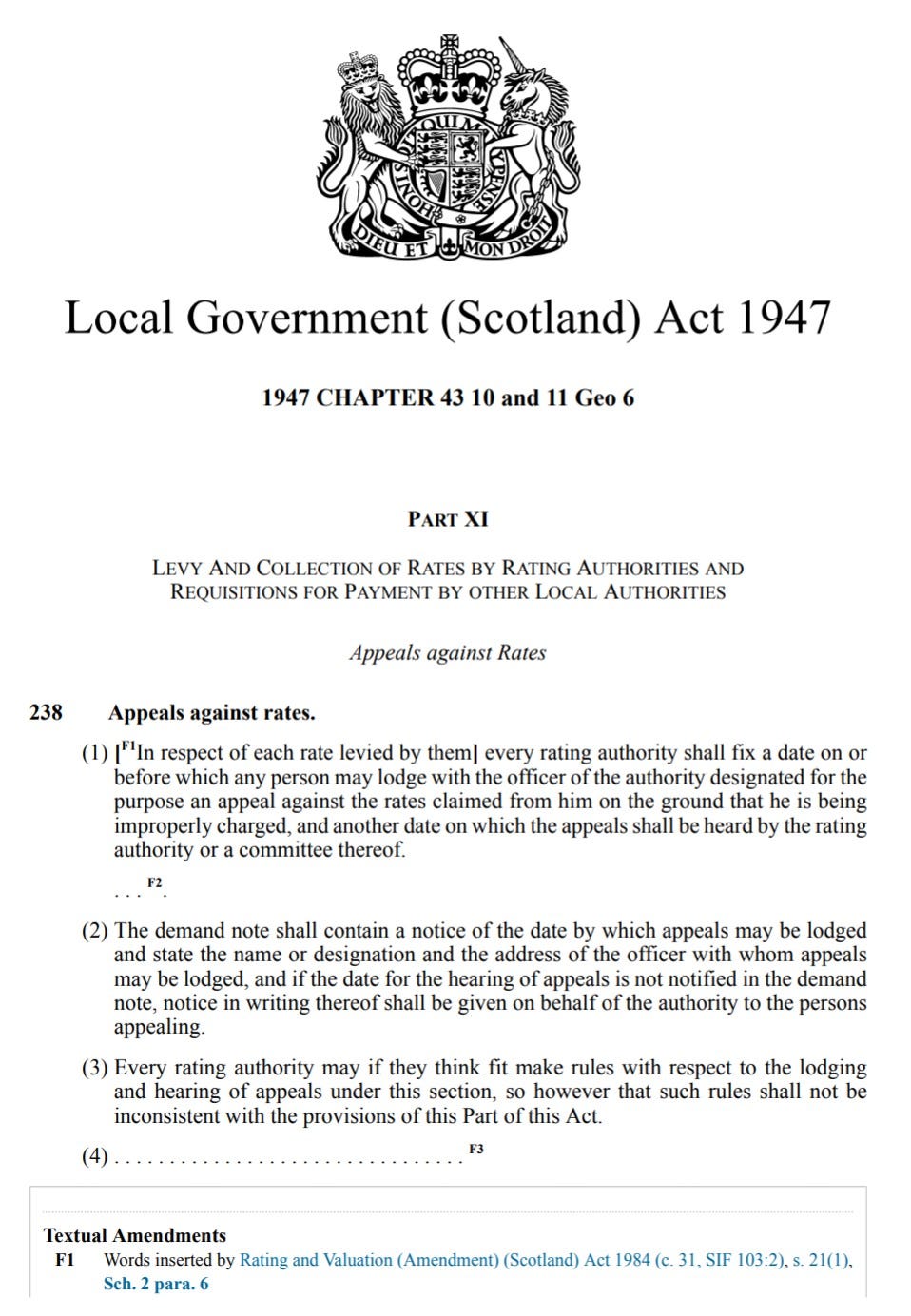
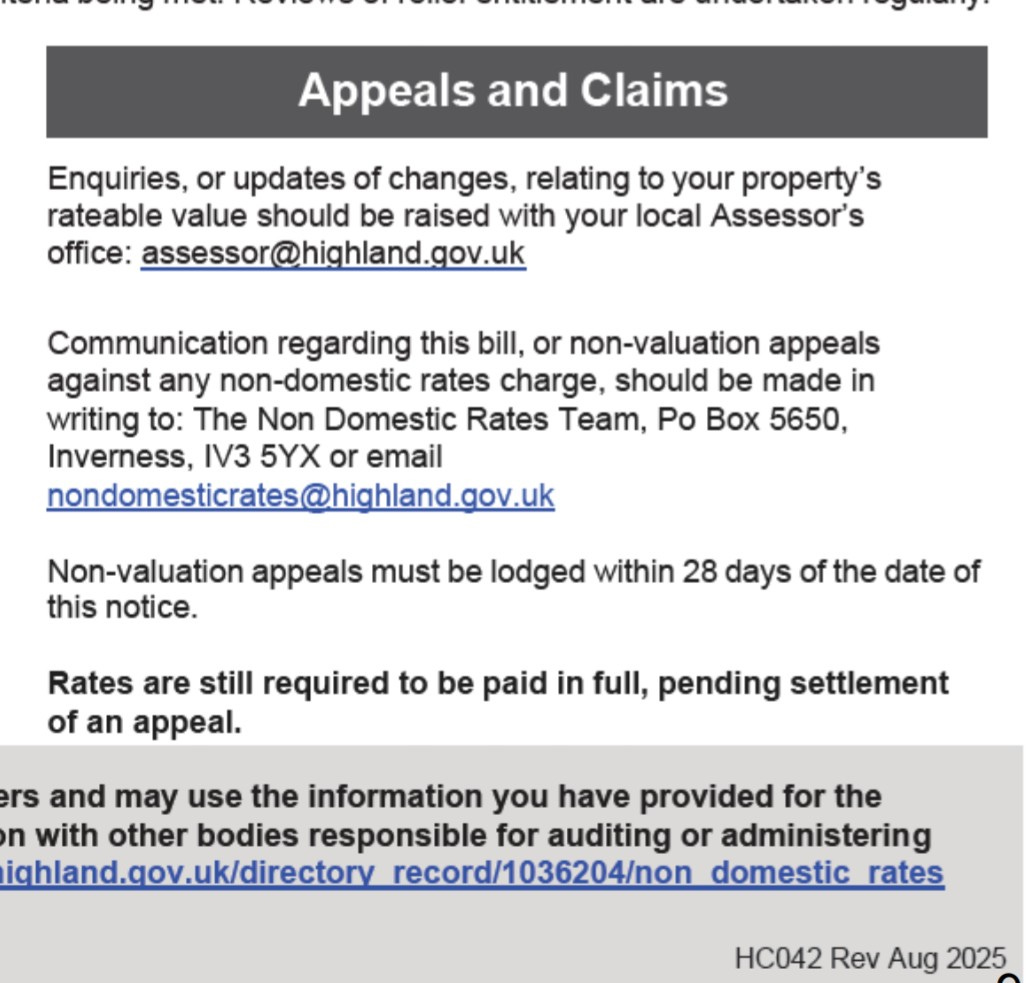
Have you ever heard of this appeal process? It's almost 80 years old. The Highland Council doesn't really want you to know about it either. As we see in s.238(2), the demand note (bill) shall contain several details about this appeal process however, the reverse of an actual demand note issued by The Highland Council say precious little about it and call them “Non-Valuation Appeals” ermm.. that's helpful. 🤔
One might assume you could find plenty of information about this appeal process on their website… ermm.. no, not really..
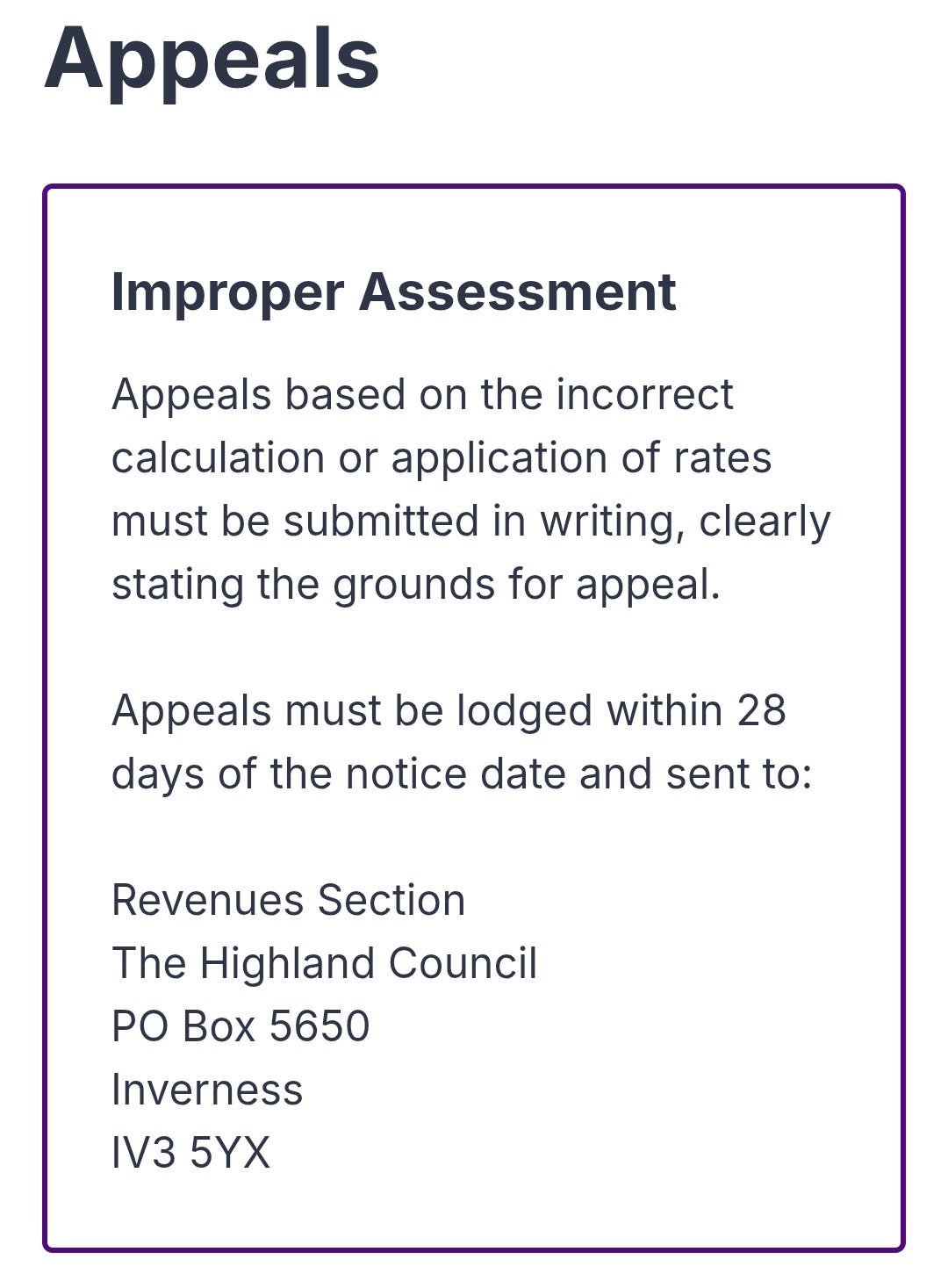
More Adventures at The Offices of “We Can't" at Glenurquhart Road & Treasure Map For How to Find The Secret Decoder Ring for the s.238 Appeal Rules Set By The Highland Council for Kangaroo Court.
There is not a single link to the rules made by the Council for these appeals on their website either as mentioned in s.238(3). So, how do you get a hold of the rule book exactly? Here's the completely absurd & obstructive process:
Send note of appeal to the Council's non-domestic rates team.
Wait 2 months for an email from Ruth Maclennan - Principal Revenues Officer to deliver a load of waffle and try to defend the decision of the Council even quoting the Data Protection Act 2018. Well, thanks for that Ruth, but, I don't think data protection law is the Council's strong suit. 😂 Then, Ruth tells you to contact Rozlyn Wheeler - Operations Manager -Revenues & Commercialisation
Wait another month and half for Rozlyn Wheeler to come back.. where she says she has “concluded her review". Really? I see nothing about the gauntlet of “Decisions by Ruth” or “Reviews by Rozlyn” in s.238 of the 1947 Act. It says, “appeals shall be heard by the Authority or a committee thereof". Not a single mention of Ruth or Rozlyn funnily enough - maybe that's in the secret rule book we haven't been given yet???
Eventually, I demand the rule book and a hearing because I was now really keen to finally clap eyes on this elusive, secret rule book of the Highland Council's Kangaroo Court and perhaps learn more about this unwritten and non-legislated process of “Decisions by Ruth” and “Reviews by Rozlyn”. I now get passed to Alasdair MacInnes - Senior Committee Officer or Democratic Services.
Alasdair finally delivers the rule book 4 months after I initially sent note. I bet readers are excited for this reveal… 😂
The Highland Council's Code of Practice for Non-Domestic Rates Appeals.
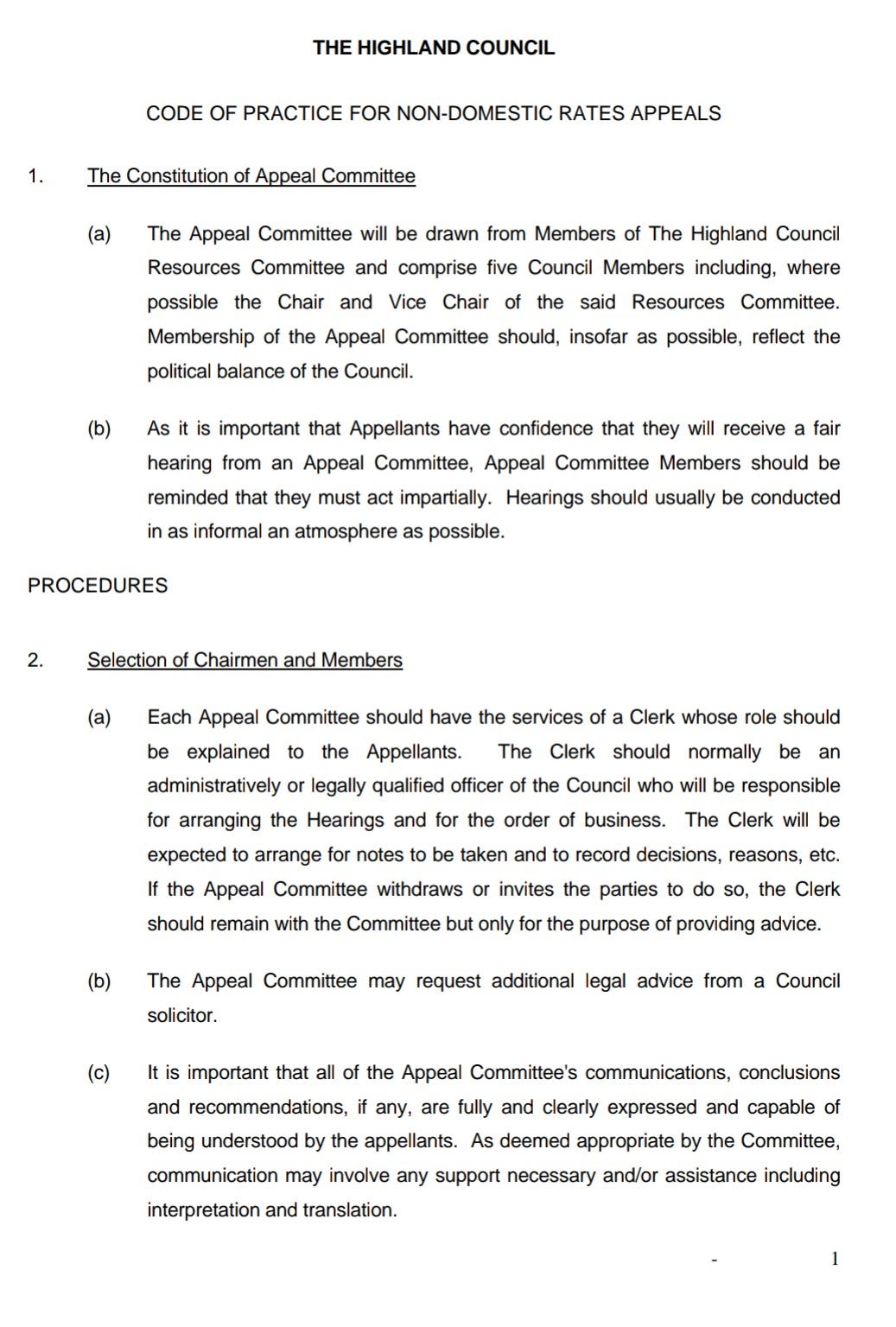
Highland Council is Resisting Setting A Hearing For The Appeal.
I wonder why the Council have thus far refused to set the hearing as required despite Alasdair assuring me way back in March 2026 that this would be done? 🤔
See below for a few good reasons they aren't so keen to put this appeal in front of the councillors…. 👇
Added full text for the benefit of Google searchers…
THE HIGHLAND COUNCIL
CODE OF PRACTICE FOR NON-DOMESTIC RATES APPEALS
1. The Constitution of Appeal Committee
(a) The Appeal Committee will be drawn from Members of The Highland Council Resources Committee and comprise five Council Members including, where possible the Chair and Vice Chair of the said Resources Committee. Membership of the Appeal Committee should, insofar as possible, reflect the political balance of the Council.
(b) As it is important that Appellants have confidence that they will receive a fair hearing from an Appeal Committee, Appeal Committee Members should be reminded that they must act impartially. Hearings should usually be conducted in as informal an atmosphere as possible.
PROCEDURES
2. Selection of Chairmen and Members
(a) Each Appeal Committee should have the services of a Clerk whose role should be explained to the Appellants. The Clerk should normally be an administratively or legally qualified officer of the Council who will be responsible for arranging the Hearings and for the order of business. The Clerk will be expected to arrange for notes to be taken and to record decisions, reasons, etc. If the Appeal Committee withdraws or invites the parties to do so, the Clerk should remain with the Committee but only for the purpose of providing advice.
(b) The Appeal Committee may request additional legal advice from a Council solicitor.
(c) It is important that all of the Appeal Committee’s communications, conclusions and recommendations, if any, are fully and clearly expressed and capable of being understood by the appellants. As deemed appropriate by the Committee, communication may involve any support necessary and/or assistance including interpretation and translation.
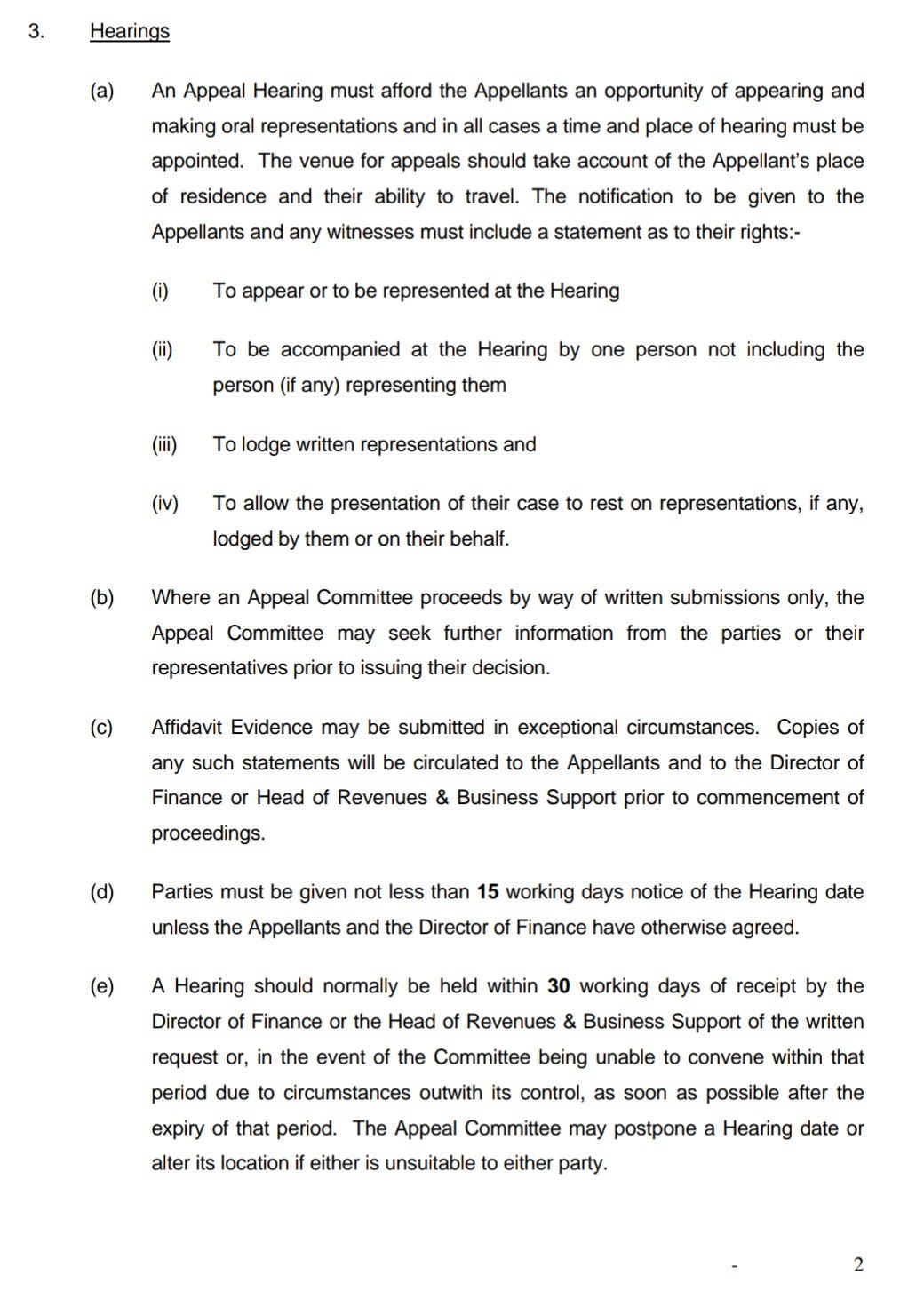
3. Hearings
(a) An Appeal Hearing must afford the Appellants an opportunity of appearing and making oral representations and in all cases a time and place of hearing must be appointed. The venue for appeals should take account of the Appellant’s place of residence and their ability to travel. The notification to be given to the Appellants and any witnesses must include a statement as to their rights:-
(i) To appear or to be represented at the Hearing
(ii) To be accompanied at the Hearing by one person not including the person (if any) representing them
(iii) To lodge written representations and
(iv) To allow the presentation of their case to rest on representations, if any, lodged by them or on their behalf.
(b) Where an Appeal Committee proceeds by way of written submissions only, the Appeal Committee may seek further information from the parties or their representatives prior to issuing their decision.
(c) Affidavit Evidence may be submitted in exceptional circumstances. Copies of any such statements will be circulated to the Appellants and to the Director of Finance or Head of Revenues & Business Support prior to commencement of proceedings.
(d) Parties must be given not less than 15 working days notice of the Hearing date unless the Appellants and the Director of Finance have otherwise agreed.
(e) A Hearing should normally be held within 30 working days of receipt by the Director of Finance or the Head of Revenues & Business Support of the written request or, in the event of the Committee being unable to convene within that period due to circumstances outwith its control, as soon as possible after the expiry of that period. The Appeal Committee may postpone a Hearing date or alter its location if either is unsuitable to either party.
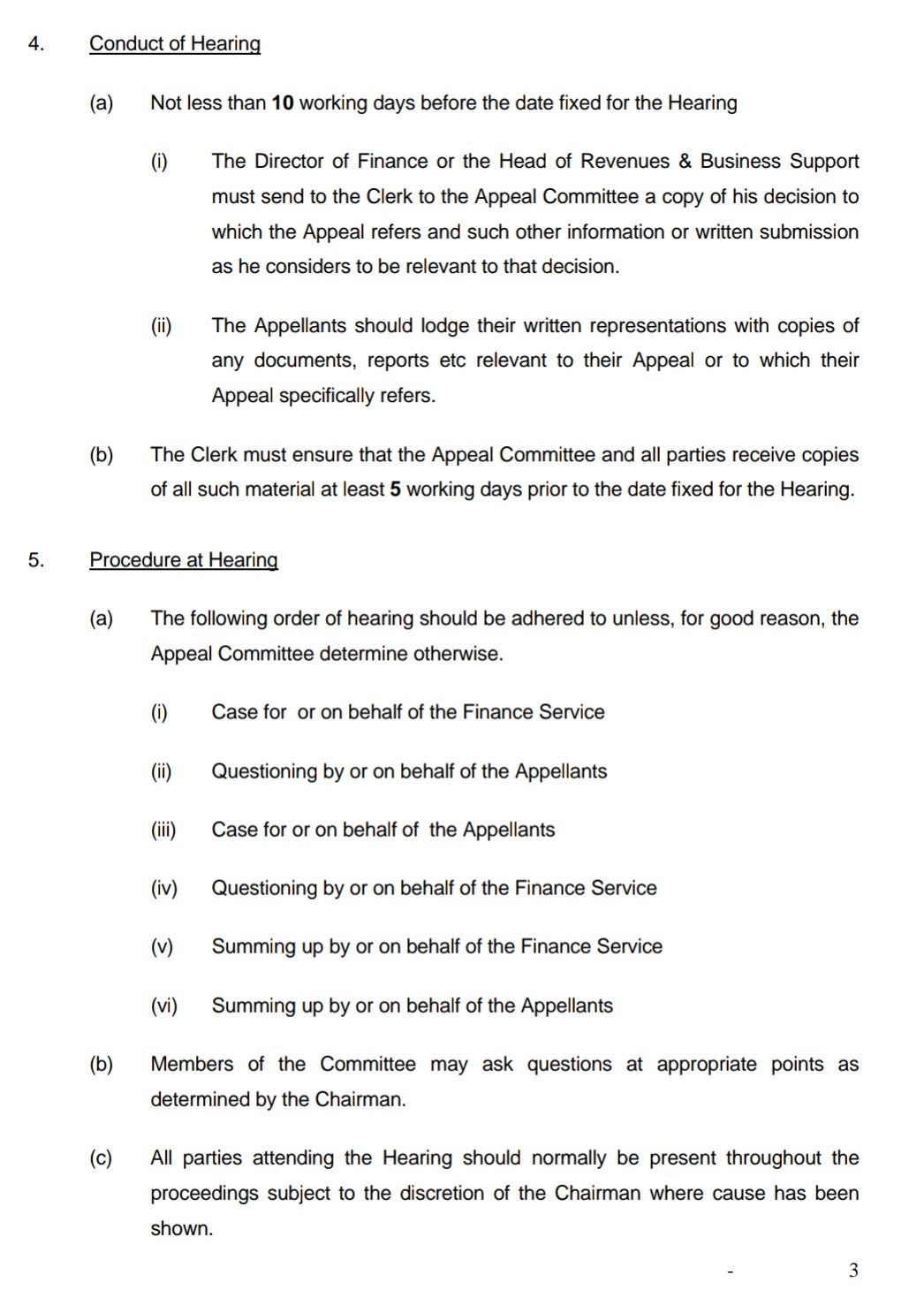
4. Conduct of Hearing
(a) Not less than 10 working days before the date fixed for the Hearing
(i) The Director of Finance or the Head of Revenues & Business Support must send to the Clerk to the Appeal Committee a copy of his decision to which the Appeal refers and such other information or written submission as he considers to be relevant to that decision.
(ii) The Appellants should lodge their written representations with copies of
any documents, reports etc relevant to their Appeal or to which their Appeal specifically refers.
(b) The Clerk must ensure that the Appeal Committee and all parties receive copies
of all such material at least 5 working days prior to the date fixed for the Hearing.
5. Procedure at Hearing
(a) The following order of hearing should be adhered to unless, for good reason, the
Appeal Committee determine otherwise.
(i) Case for or on behalf of the Finance Service
(ii) Questioning by or on behalf of the Appellants
(iii) Case for or on behalf of the Appellants
(iv) Questioning by or on behalf of the Finance Service
(v) Summing up by or on behalf of the Finance Service
(vi) Summing up by or on behalf of the Appellants
(b) Members of the Committee may ask questions at appropriate points as
determined by the Chairman.
(c) All parties attending the Hearing should normally be present throughout the proceedings subject to the discretion of the Chairman where cause has been shown.
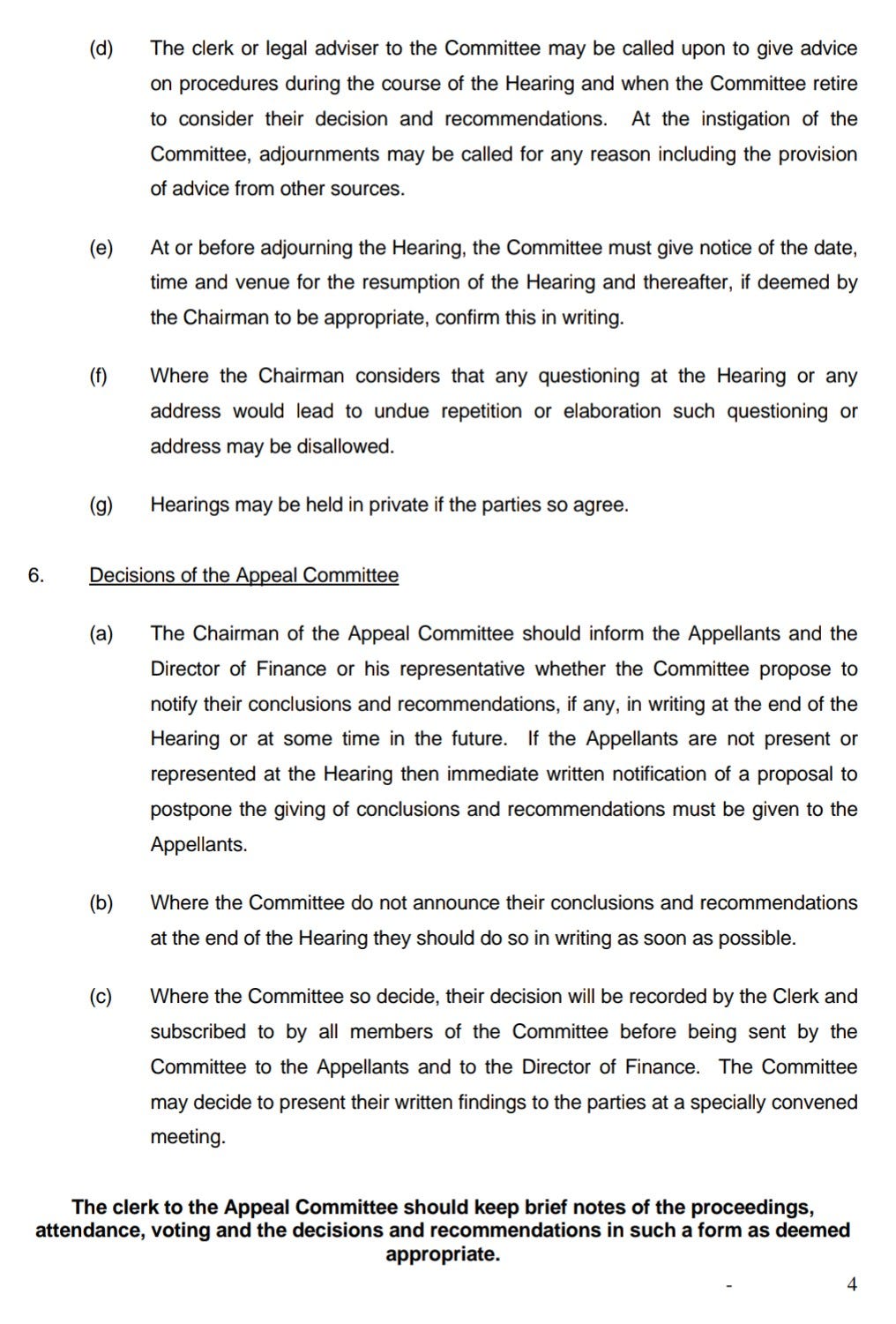
(d) The clerk or legal adviser to the Committee may be called upon to give advice on procedures during the course of the Hearing and when the Committee retire to consider their decision and recommendations. At the instigation of the Committee, adjournments may be called for any reason including the provision of advice from other sources.
(e) At or before adjourning the Hearing, the Committee must give notice of the date, time and venue for the resumption of the Hearing and thereafter, if deemed by the Chairman to be appropriate, confirm this in writing.
(f) Where the Chairman considers that any questioning at the Hearing or any address would lead to undue repetition or elaboration such questioning or address may be disallowed.
(g) Hearings may be held in private if the parties so agree.
6. Decisions of the Appeal Committee
(a) The Chairman of the Appeal Committee should inform the Appellants and the Director of Finance or his representative whether the Committee propose to notify their conclusions and recommendations, if any, in writing at the end of the Hearing or at some time in the future. If the Appellants are not present or represented at the Hearing then immediate written notification of a proposal to postpone the giving of conclusions and recommendations must be given to the Appellants.
(b) Where the Committee do not announce their conclusions and recommendations at the end of the Hearing they should do so in writing as soon as possible.
(c) Where the Committee so decide, their decision will be recorded by the Clerk and subscribed to by all members of the Committee before being sent by the Committee to the Appellants and to the Director of Finance. The Committee may decide to present their written findings to the parties at a specially convened meeting.
The clerk to the Appeal Committee should keep brief notes of the proceedings, attendance, voting and the decisions and recommendations in such a form as deemed appropriate.